AI Daily — August 26, 2026

Models & Research
AI models still struggle with classic intelligence puzzles — A review of long-standing puzzle and game benchmarks shows current AI systems still stumble on tasks designed to probe reasoning and general intelligence, offering a way for readers to test their own performance against the machines. MIT Tech Review ↗
My takeaway: A benchmark scores tells you what a model has seen. Only your own perturbed eval harness tells you what it can do.
Study questions reliability of FID as an image-generation metric — Hao Chen (UC Davis) argues in an arXiv preprint (2608.24881) that FID is blind by construction: any two distributions sharing a mean and covariance score zero. His stress test optimized 512 noise images to match an ImageNet reference's Inception moments and got FID 24.7 against a 58.6 real–real baseline — visual noise beating real photographs. FID also reverses the dispersion-collapse ordering (ρ = −.41). The proposed replacement, ZID, splits the job into a severity index, a permutation p-value, and a signed readout separating mode collapse from over-dispersion. arXiv ↗
My takeaway: One number can't do everything. If you use the same metric to rank, test, and diagnose a model, it will eventually miss something important (Usually the part you're not paying attention to).
Industry & Funding
Funding Summary:
- Gatik lands $200M to expand driverless freight trucks
- Robotics firm Generalist's valuation jumps to $3B
- Stability AI secures $76M in new funding
- Hearing-tech startup Legato debuts AI-powered smart glasses with $12M in funding
- Runable raises $21M betting on agents that grow businesses
- India's Ringg raises $10M to push voice AI beyond calls
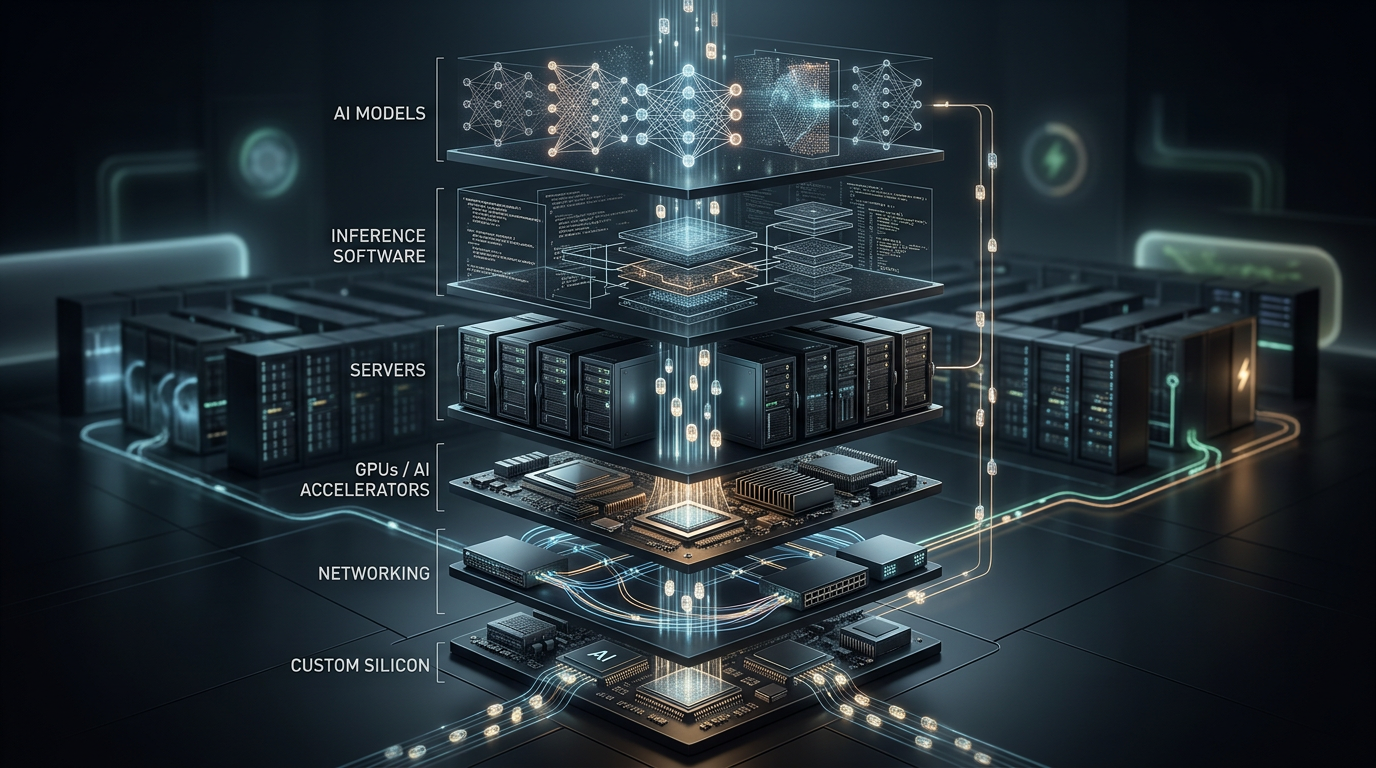
OpenAI publishes its own Jalapeño benchmarks, run on a third-party harness — OpenAI ran its first custom inference chip on InferenceX, SemiAnalysis's public benchmark, and reports 1.5–1.9× more work per watt and 1.7–3.6× lower latency than current-generation Nvidia parts (GB200 and GB300) across GPT-OSS 120B, DeepSeek R1, and Kimi K2.5. Results are normalized on published power ratings — 700 W for Jalapeño against 1,200–1,400 W for Nvidia. Deployment starts inside OpenAI's own infrastructure by year-end, with Nvidia hardware still in the mix. OpenAI ↗
My takeaway: OpenAI's strategy is to control more of the stack, all the way down to the chips, to reduce inference costs and latency. The key metric is how many tokens it can generate per kilowatt, because that directly affects the economics of running AI.
Policy & Society
Bill Gates warns AI has crossed key risk thresholds — In a wide-ranging conversation, Bill Gates said society has already passed certain danger points associated with AI development and discussed what should happen next to manage the risks. MIT Tech Review ↗
My takeaway: AI-powered cyberattacks are no longer just a future risk.
Summaries are AI-generated and may contain errors — always verify against the linked original. Each story links to its source, which holds the copyright. Outlet names are shown for attribution only and do not imply any endorsement or affiliation.
Disclaimer: The views expressed in My Takeaway are my own personal opinions and general observations on industry trends. They are not intended to criticize, disparage, or make factual claims about any specific company, product, or platform. Any platform names mentioned are referenced solely for illustrative and informational purposes.